

- Status
- Verified
- Base model
- …
- Lineage
- …
- Unchanged from base
- …
- Trending
- #2
- Downloads, 30 days
- 37.6k
- Weights
- 3.5 GB
- Revision
LFM3-1.7B is a text model for local agents and specialized applications, based on our new tri-hybrid architecture.
At a glance
- Task
- Text generation
- Input
- text
- Output
- text
- Parameters
- 1.7B
- Architecture
- Lfm3
- Context
- 256K tokens
- Precision
- BF16
- Format
- Safetensors
- Library
- transformers
- License
- other
- Languages
- en, ar, zh, fr, de, it, ja, ko +8
- Base model
- Fine tuned from LiquidAI/LFM3-1.7B-Base
- Released
- Oct 2026
- Updated
- Oct 2026
- Likes
- 435
- Downloads, all time
- 8,892
Architecture
- Layers
- 24
- Hidden size
- 2,048
- Attention
- 16 heads, grouped query, 4 KV heads
- Vocabulary
- 128,000
- Positions
- 262,144
- Tied embeddings
- Yes
Benchmarks
7 results, self reported by the authors.
| Benchmark | Score | Date | Evidence |
|---|---|---|---|
| harborframework/terminal-bench-2.1terminalbench_2_1 | 12.92 | Oct 2026 | Reported by source |
| SWE-bench/SWE-bench_Verifiedswe_bench_%_resolved | 43.4 | Oct 2026 | Reported by source |
| SWE-bench/SWE-bench_Multilingualswe_bench_multilingual_%_resolved | 23 | Oct 2026 | Reported by source |
| claw-eval/Claw-Evalgeneral | 51.4 | Oct 2026 | Reported by source |
| Idavidrein/gpqadiamond | 63.37 | Oct 2026 | Reported by source |
| cais/hlehle | 7.17 | Oct 2026 | Reported by source |
| LiquidAI/ifstruct-v1.0ifstruct_v1 | 93.72 | Oct 2026 | Reported by source |
Family
Models built on LFM3-1.7B.
Run it
Loads with Transformers AutoModelForCausalLM, pinned to the indexed revision.
from transformers import AutoModelForCausalLM

model = AutoModelForCausalLM.from_pretrained("LiquidAI/LFM3-1.7B", revision="ac2586a34f1a1c03329dbdcdefabd8b6478ddaa7")
Through the hub: the same tools, each file from a source that is up (Hugging Face, ModelScope, IPFS), at this revision. The second line checks every file against its address.
export HF_ENDPOINT=https://gethologram.ai
cd "$(hf download LiquidAI/LFM3-1.7B --quiet)" && curl -s $HF_ENDPOINT/LiquidAI/LFM3-1.7B/resolve/main/SHA256SUMS | sha256sum -c --quiet
Spaces
Used in 6 Spaces.
Read the full model card

[API](https://console.liquid.ai/dashboard)
[Try](https://playground.liquid.ai/)
[Docs](https://docs.liquid.ai/lfm/getting-started/welcome)
[Blog](https://www.liquid.ai/blog/lfm3)
LFM3-1.7B
LFM3-1.7B is a text model for local agents and specialized applications, based on our new tri-hybrid architecture.
- Agentic training: post-trained for agentic harnesses such as Hermes Agent, Pi, and OpenClaw, with a 256K-token context window.
- Designed for the edge: at 4-bit precision, it takes about 1 GB of memory, so it fits on any phone or laptop.
- Made to be specialized: adapt the model to your domains, formats, and tools via quick single-GPU fine-tuning.
Find more information about the LFM3 family in our release blog post.
Model details
The LFM3 family includes base, text, vision, audio, omni, and decision models.
Property Specification
Checkpoint Post-trained, text-only language model
Parameters 1.73B
Architecture 24 layers: 13 gated short convolutions, 5 sliding-window attention, 6 global attention
Context length 256K tokens (input + output)
Vocabulary 128,000 tokens
Languages English, Arabic, Chinese, French, German, Italian, Japanese, Korean, Portuguese, Spanish, Vietnamese, Thai, Indonesian, Hindi, Russian, Polish
License LFM Open License v1.0
LFM3-1.7B is designed for local agents, tool calling, structured outputs, and domain-specific fine-tuning. Use retrieval or search for knowledge-heavy tasks. It is not recommended for agentic coding or complex multi-step reasoning due to its small size.
Inference
Choose a checkpoint variant for your inference framework and hardware.
Checkpoint Framework Description
BF16 vLLM, SGLang, Transformers BF16 weights for GPU inference.
FP8 SGLang FP8 quantization for GPU inference.
NVFP4 SGLang 4-bit floating-point quantization for GPU inference.
GGUF llama.cpp, Ollama, LM Studio Local inference on CPUs and GPUs.
MLX MLX 4-bit quantization for Apple Silicon.
ONNX ONNX Runtime Cross-platform inference with ONNX Runtime.
Sampling parameters:
- General (chat, tool use, agents, coding):
temperature=0.1,top_k=50, repetition_penalty=1.1 - Math & STEM (math, science):
temperature=1.0, top_p=0.95, top_k=20
Transformers quick start:
from transformers import pipeline

generator = pipeline(
    "text-generation",
    model="LiquidAI/LFM3-1.7B",
    trust_remote_code=True,
)

messages = [{"role": "user", "content": "What is C. elegans?"}]
output = generator(
    messages,
    do_sample=True,
    temperature=0.1,
    top_k=50,
    repetition_penalty=1.1,
    max_new_tokens=2048,
)
print(output[0]["generated_text"][-1]["content"])
For local agent setup, see the Agent Harnesses guide.
Chat template
LFM3 uses this ChatML format, generated from the checkpoint's chat template:
<|startoftext|><|im_start|>system
You are a helpful assistant trained by Liquid AI.<|im_end|>
<|im_start|>user
Explain how a heat pump works.<|im_end|>
<|im_start|>assistant
<think>
Use tokenizer.apply_chat_template() with add_generation_prompt=True to format messages automatically.
Reasoning is enabled by default. You can set enable_thinking=False to disable thinking traces, but this behavior can be inconsistent, especially for reasoning-heavy tasks.
Reasoning from turns before the latest user message is removed unless preserve_thinking=True.
Tool calling
Pass function schemas through tools=... to apply_chat_template(). The template formats tool definitions and results automatically. Generated calls use XML:
<tool_call>
<function=get_weather>
<parameter=city>
Paris
</parameter>
</function>
</tool_call>
Execute the call in your application. Add the parsed assistant call to history as a tool_calls entry, then append the result as a tool message. Keep passing the tool schemas on subsequent requests and preserve the assistant's content and reasoning from the current tool-use turn.
function.arguments must be a Python mapping. Decode JSON strings with json.loads() before applying the template.
Tool search
LFM3 supports deferred tools. Set defer_loading=True to keep tool definitions out of the prompt until your harness's search tool returns their names as tool_reference parts. The chat template then inserts their definitions into <additional_tools>.
tools = [
    search_tool,
    {"type": "function", "defer_loading": True, "function": get_weather_schema},
]
messages.append({
    "role": "tool",
    "tool_call_id": call_id,
    "content": [
        {"type": "text", "text": "Found 1 tool."},
        {"type": "tool_reference", "name": "get_weather"},
    ],
})
Your harness implements and runs the search. Keep the full tools list, including deferred tools, on every request. In the system prompt, tell the model when to search:
You only have one tool right now: search_tools, which searches a catalog of many more tools. If none of your current tools can handle a request, call search_tools to find one, then call the tool it returns.
Works with vLLM, SGLang, and LFM3-compatible llama.cpp builds. For llama.cpp, use a GGUF with the current chat template or load it with --chat-template-file.
See Deferred tools and tool search for the full guide.
Fine-tuning
LFM3-1.7B is designed for easy customization for a given domain, task, or application via TRL.
Training Use case Notebook
SFT Extract structured JSON from messy documents Open in Colab
DPO Answer from retrieved documents, or decline Open in Colab
GRPO Call the right tools in a 108-tool phone app Open in Colab
CPT Learn a new language (Turkish) from raw text Open in Colab
Performance
Benchmarks
LFM3-1.7B can power agentic applications that used to need 9B parameters.
Benchmark
LFM3
1.7B
LFM2.5
2.6B
MiniCPM5
2B
Gemma 4
E4B
Qwen3.5
4B
Qwen3.5
9B
Agents
LiveClaw 45.60 14.70 30.37 20.36 19.94 35.77
Claw-Eval General (EN), average 68.64 62.63 60.74 56.14 61.96 66.53
Claw-Eval General (EN), pass^3 51.40 37.52 34.58 22.43 42.99 51.87
BrowseComp-Plus (OpenClaw subset) 37.00 26.33 16.83 21.00 24.67 38.00
WebArena-Verified 38.42 3.02 9.11 17.06 21.92 28.94
EnterpriseOps-Gym 28.20 7.94 13.41 9.86 25.96 28.97
AutomationBench (public) 41.29 0.94 4.71 1.92 8.67 15.10
Tool use
BFCL V4 71.39 55.89 62.65 48.25 55.12 62.83
ToolSandbox 80.36 78.04 68.16 69.27 75.40 76.41
MCP-Atlas 32.57 16.45 26.38 6.19 41.37 42.67
τ³-bench (4 domains), average 68.01 56.77 69.44 33.53 65.98 67.11
Agentic coding
SWE-bench Verified (OpenCode) 43.40 18.00 34.80 0.50 41.20 51.20
SWE-bench Multilingual (OpenCode) 23.00 8.00 15.67 0.67 23.33 35.00
Terminal-Bench 2.1 (OpenCode) 12.92 0.00 5.62 0.00 13.48 17.98
Coding
LiveCodeBench v6 73.46 60.57 70.52 71.00 61.99 69.86
LiveCodeBench Pro 25Q231.7419.1629.3429.9424.2534.43
SciCode 28.47 16.32 27.78 25.00 23.02 31.60
Instruction following
IFEval96.6695.3987.8390.0292.5292.08
IFBench73.0360.4862.0844.5638.1648.84
IFStruct93.7282.1872.6578.4587.0589.20
Multi-IF 89.10 84.80 73.19 81.03 80.32 84.44
Knowledge
GPQA Diamond63.3757.7865.1557.8875.7680.40
Humanity's Last Exam (no tools)7.175.888.204.7712.8416.41
Humanity's Last Exam (with tools)13.909.6011.506.0011.6017.50
AA-Omniscience (public)0.50-33.17-5.00-15.33-57.17-28.00
AA-Omniscience accuracy (public)7.078.759.139.8315.6713.17
AA-Omniscience non-hallucination (public)92.9353.6984.4472.0913.6452.59
Long context
AA-LCR 52.83 6.00 49.34 39.33 52.67 62.00
RULER 128K 65.56 1.15 37.96 18.82 84.63 87.11
Average49.3731.5539.1931.7439.2747.24
Evaluation details
All models were served with vLLM in BF16 at their full context length: 262,144 tokens for LFM3-1.7B, Qwen3.5-4B, and Qwen3.5-9B, and 131,072 tokens for LFM2.5-2.6B, MiniCPM5-2B, and Gemma 4 E4B. Unless listed below, every eval uses temperature 0.6 and top_p 0.95, with no output limit other than the context length. The Average row is the unweighted mean of every score in the table.
BFCL V4: greedy decoding, up to 32,768 output tokens.
ToolSandbox: greedy decoding, up to 1,024 tokens per turn.
LiveClaw: OpenClaw agent, up to 8,192 tokens per turn.
Claw-Eval: greedy decoding, 3 trials per task.
BrowseComp-Plus: OpenClaw agent, greedy decoding, up to 8,192 tokens per turn.
WebArena-Verified: up to 40 steps.
MCP-Atlas: up to 256 turns.
EnterpriseOps-Gym and AutomationBench: up to 50 turns.
SWE-bench: OpenCode agent, up to 250 turns.
Terminal-Bench 2.1: OpenCode agent, up to 100 turns.
Edge inference
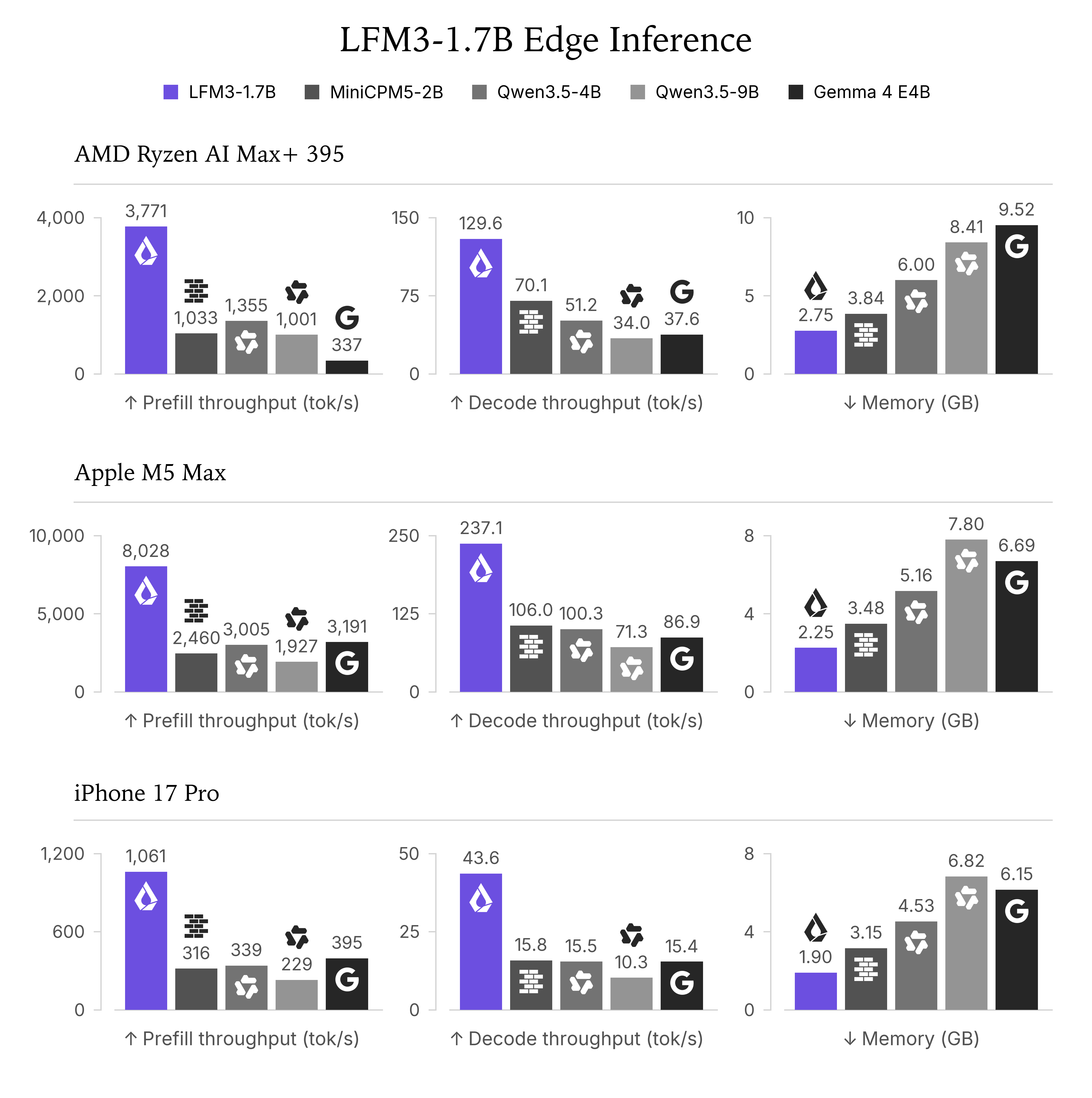
At 32K context, LFM3-1.7B prefills at least 2.5x faster and decodes at least 1.8x faster than every compared model on all three devices, while using the least memory.

Evaluation details
All models run as Q4_0 GGUF files in llama.cpp with 32,768 tokens of context, batch size 1, 100 output tokens, and GPU offload. Prefill is the prompt processing speed and decode is the generation speed, both in tokens per second. LFM3-1.7B uses a llama.cpp build with LFM3 support, and the other models use llama.cpp release b11744.
AMD Ryzen AI Max+ 395: Radeon 8060S integrated GPU, Windows, Vulkan backend.
Apple M5 Max: macOS, Metal backend.
iPhone 17 Pro: Apple A19 Pro, iOS app built on llama.cpp.
Memory: peak usage in GB (109 bytes). On AMD, it adds the host and GPU peaks from the same run, which can slightly overstate usage if the two peaks do not coincide. On Apple devices, the process footprint already includes Metal allocations.
GPU inference
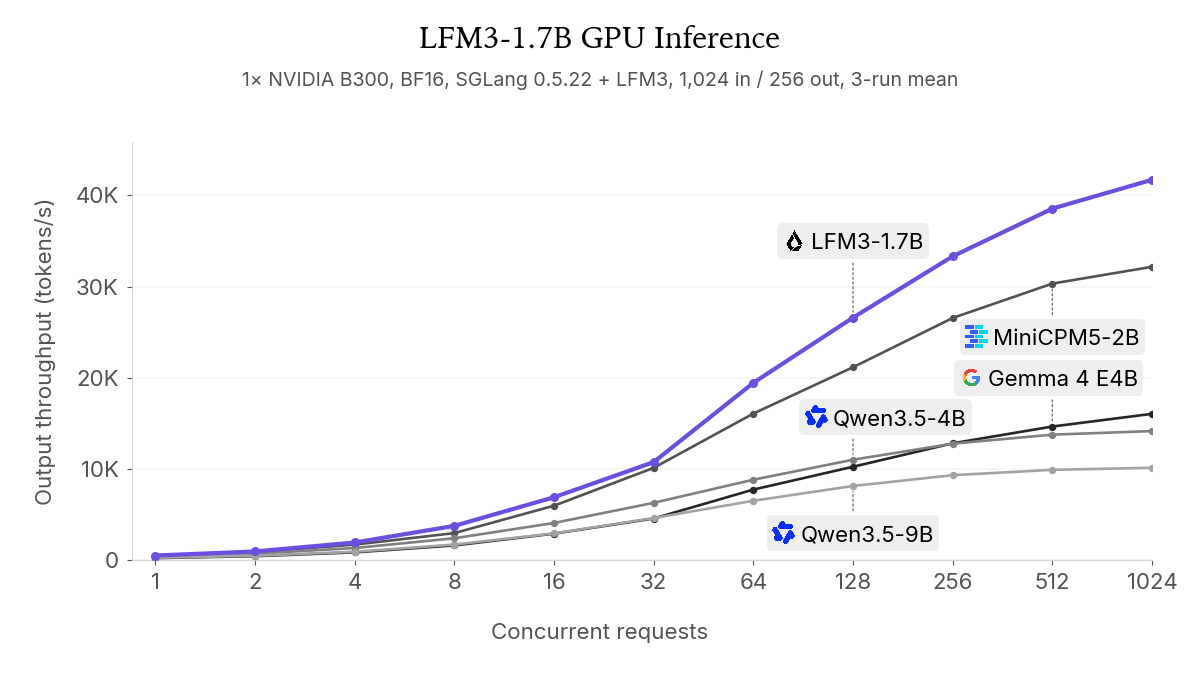
At 1,024 concurrent requests, LFM3-1.7B can produce 3.6 billion tokens/day on one NVIDIA B300.

Training

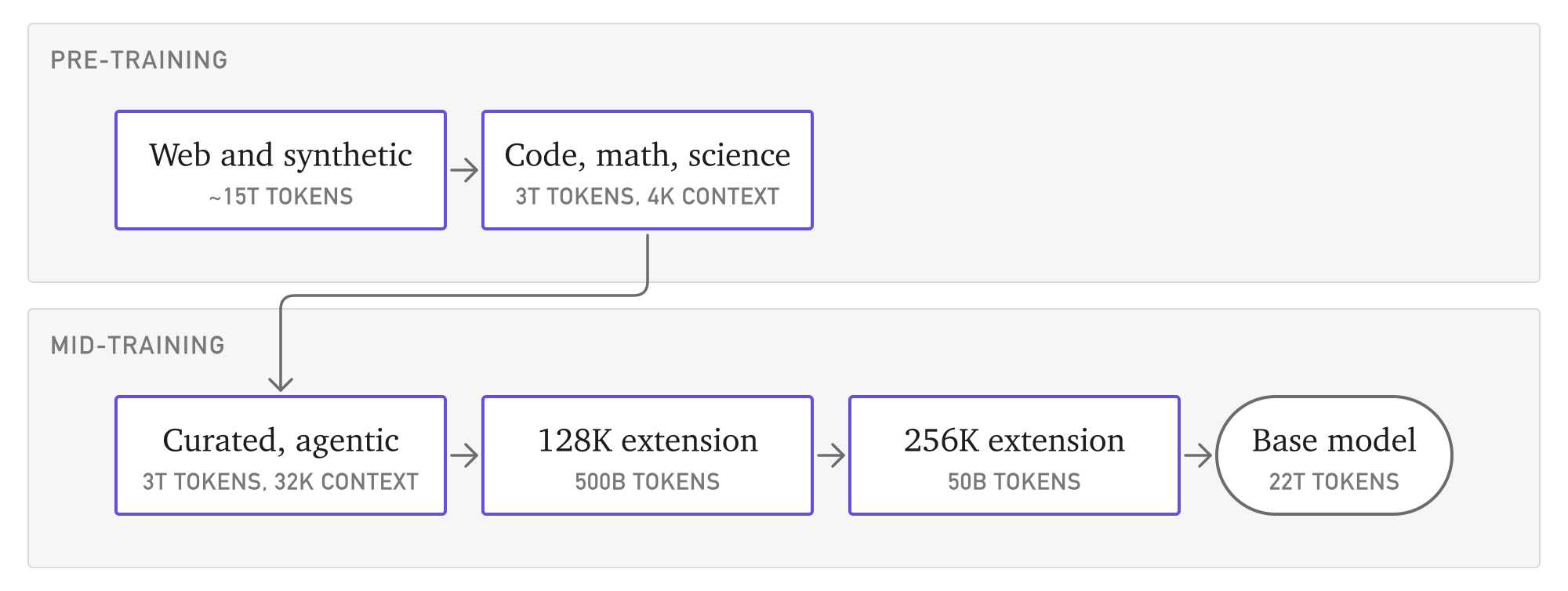
Pre-training: two stages build LFM3-1.7B-Base on 22T tokens in total.
- Main pre-training: compared with LFM2, the mix adds more scientific papers, repository-level code, math, and a wider range of knowledge sources.
- Mid-training: the last 3.5T tokens use curated, higher-quality data with a larger share of agentic traces and tool calls. This stage also extends the context window to 256K tokens.

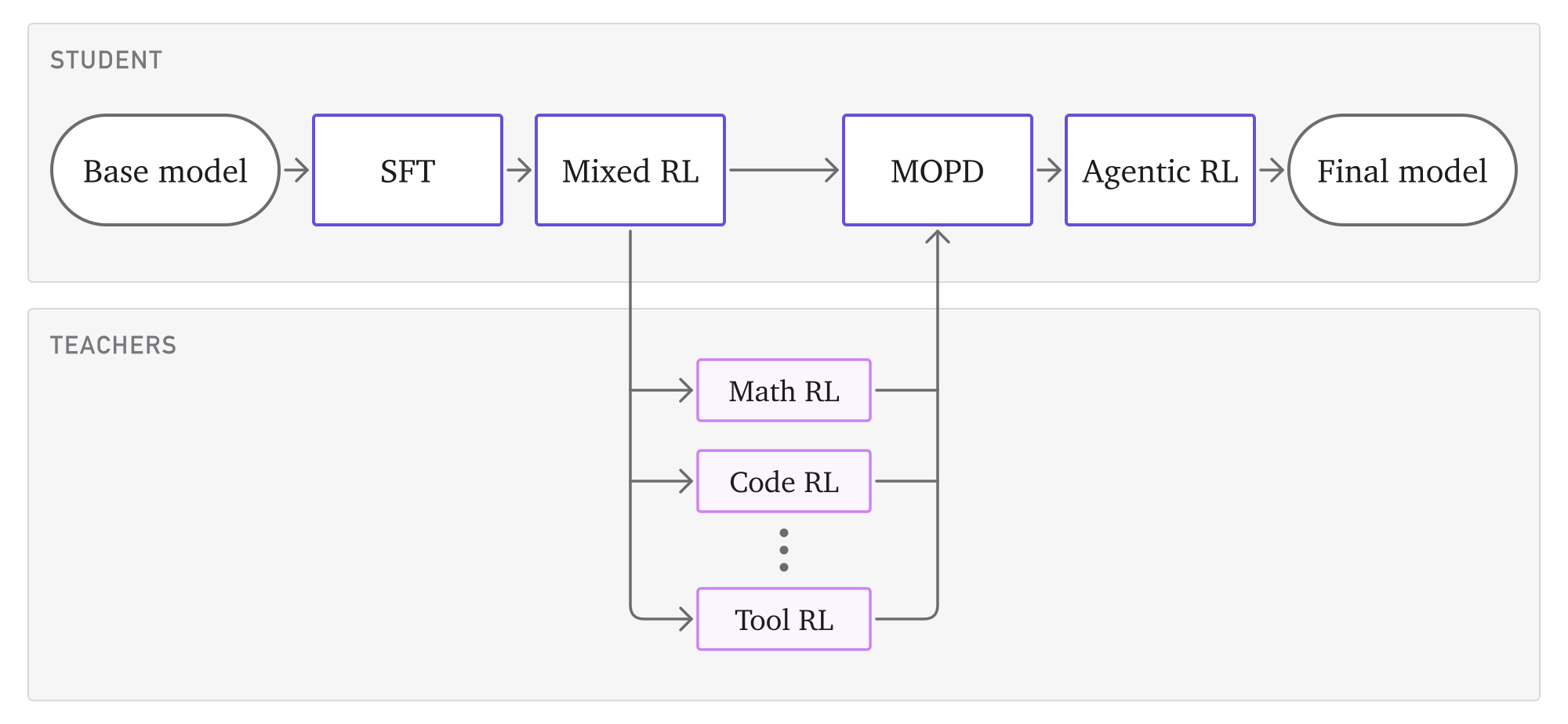
Post-training: four stages develop conversation, reasoning, and tool-use capabilities.
- Supervised fine-tuning (SFT): 1.75T tokens across various tasks, including chat, reasoning, tool calling, and agentic traces.
- Mixed reinforcement learning: many domains trained at once, from math and code to SQL and structured outputs. A length penalty in the reward keeps answers concise.
- Multi-domain on-policy distillation (MOPD): six specialist RL teachers (code, math, tool use, long context, agentic work, and enterprise workflows) are distilled back into a single model.
- Agentic RL: tasks from web browsing to office work are run inside real agent harnesses, preparing the model for deployment.
Citation
@article{liquidAI2026LFM3,
  author  = {Liquid AI},
  title   = {Introducing LFM3: Every Modality for Specialized Intelligence},
  journal = {Liquid AI Blog},
  year    = {2026},
  note    = {www.liquid.ai/blog/lfm3},
}
For questions and feedback, join Discord. For custom deployment and fine-tuning support, contact Liquid AI.
Derived on Oct 29, 2026 from Hugging Face at revision ac2586a3, README.md , config.json .
23 files, 3.5 GB. Every download is checked against its address.