

- Status
- Verified
- Trending
- #8
- Downloads, 30 days
- 19.8k
- Weights
- 8.4 GB
- Sources
- 2
- Revision
- Manifest
NeoHorse-1-4B is a 4B causal language model and an initial prototype on the path toward recursive self-improvement (RSI). It is post-trained from Qwen3.5-4B for text-based agent harnesses, tool use, coding, and instruction following.
At a glance
- Task
- Text generation
- Input
- text
- Output
- text
- Parameters
- 4.2B
- Architecture
- Qwen 3.5 Text
- Context
- 256K tokens
- Precision
- BF16
- Format
- Safetensors
- Library
- transformers
- License
- Apache 2.0Commercial use
- Base model
- Fine tuned from Qwen/Qwen3.5-4B
- Released
- Sep 2026
- Updated
- Sep 2026
- Likes
- 2,102
- Downloads, all time
- 16,163
Architecture
- Layers
- 32
- Hidden size
- 2,560
- Attention
- 16 heads, grouped query, 4 KV heads
- Vocabulary
- 248,320
- Positions
- 262,144
- Tied embeddings
- Yes
Family
Models built on NeoHorse-1-4B.
Run it
Loads with Transformers AutoModelForCausalLM and AutoTokenizer, pinned to the indexed revision.
from transformers import AutoModelForCausalLM, AutoTokenizer

model = AutoModelForCausalLM.from_pretrained("TokenRhythm/NeoHorse-1-4B", revision="56f0584bb40578a2c33b1b40a08ccd17243ad710")
processor = AutoTokenizer.from_pretrained("TokenRhythm/NeoHorse-1-4B", revision="56f0584bb40578a2c33b1b40a08ccd17243ad710")
Papers
- NeoHorse-1: Towards Recursive Self-Improvement via Agentic Post-Training with Routing HarnessNeoHorse Team et al., 2026
Spaces
Used in 1 Spaces.
Read the full model card
NeoHorse-1-4B
Towards Recursive Self-Improvement via Agentic Post-Training with Routing Harness.
GitHub ModelScope Hugging Face Company Twitter / X License: Apache-2.0
NeoHorse-1-4B is a 4B causal language model and an initial prototype on the path toward recursive self-improvement (RSI). It is post-trained from Qwen3.5-4B for text-based agent harnesses, tool use, coding, and instruction following.
Derived from Qwen/Qwen3.5-4B and fine-tuned by TokenRhythm. This release contains language-model weights only and is repackaged for text-only inference. Vision weights are not included. Repackaging changes configuration and tensor key names, without changing the fine-tuned tensor values.

Highlights
- Path toward RSI: the routing harness assigns tasks to a heterogeneous model pool, records tool interactions and outcomes, estimates capability demand, and uses capability-level feedback to shape the next training mixture. Updated models can return to the harness, closing a prototype evaluation–selection–update loop; extending this loop across successive iterations is the next step toward RSI.
- Agentic post-training framework: the associated research explores routing-guided curriculum SFT and routing-guided on-policy distillation to turn execution trajectories into training signal while preserving execution and harness context around each response.
- Data quality: exact and near-duplicate removal, evaluation decontamination, structural validation, six-dimensional semantic evaluation, and subscene-level Scene/Goal/Outcome labeling.
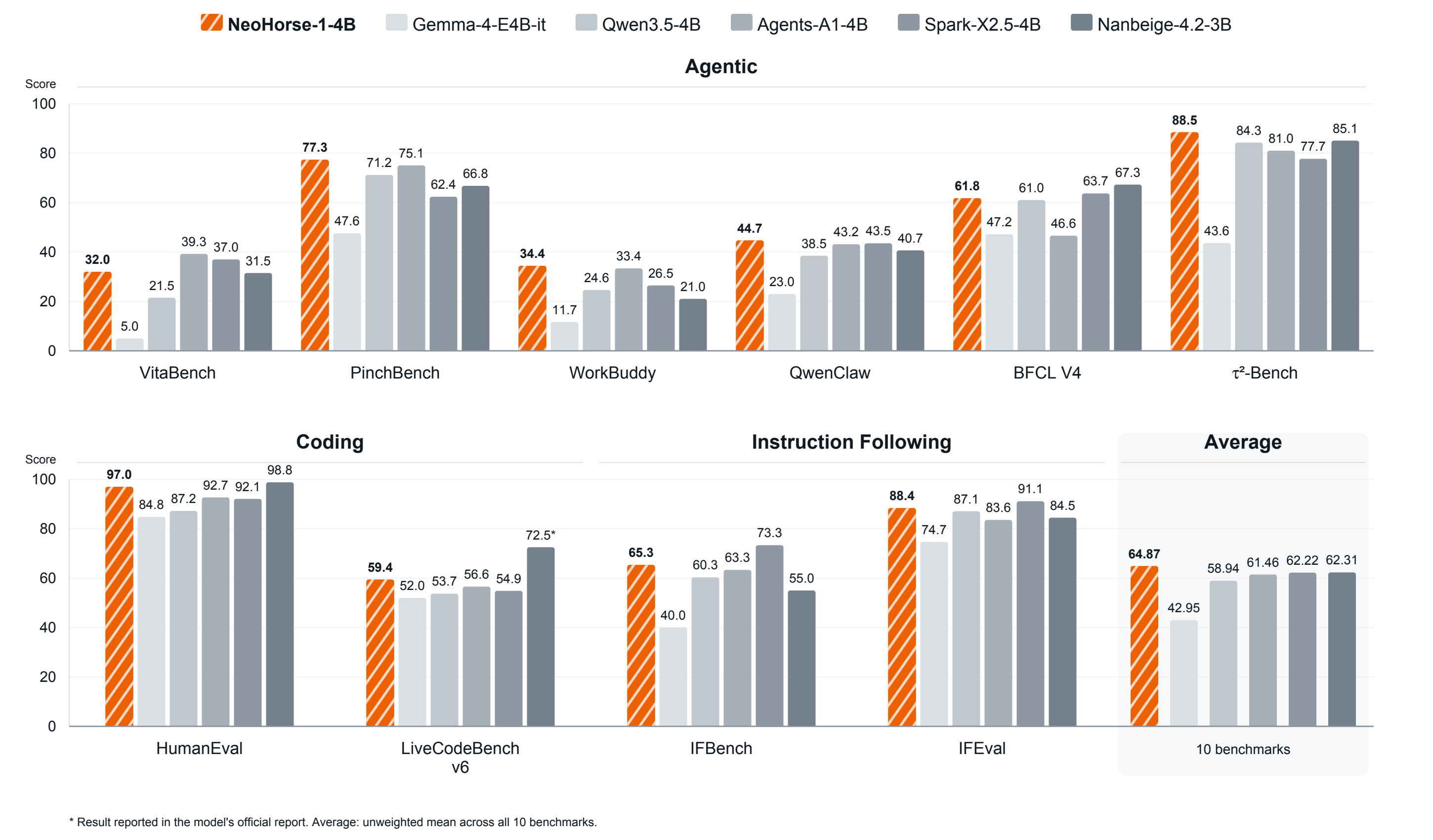
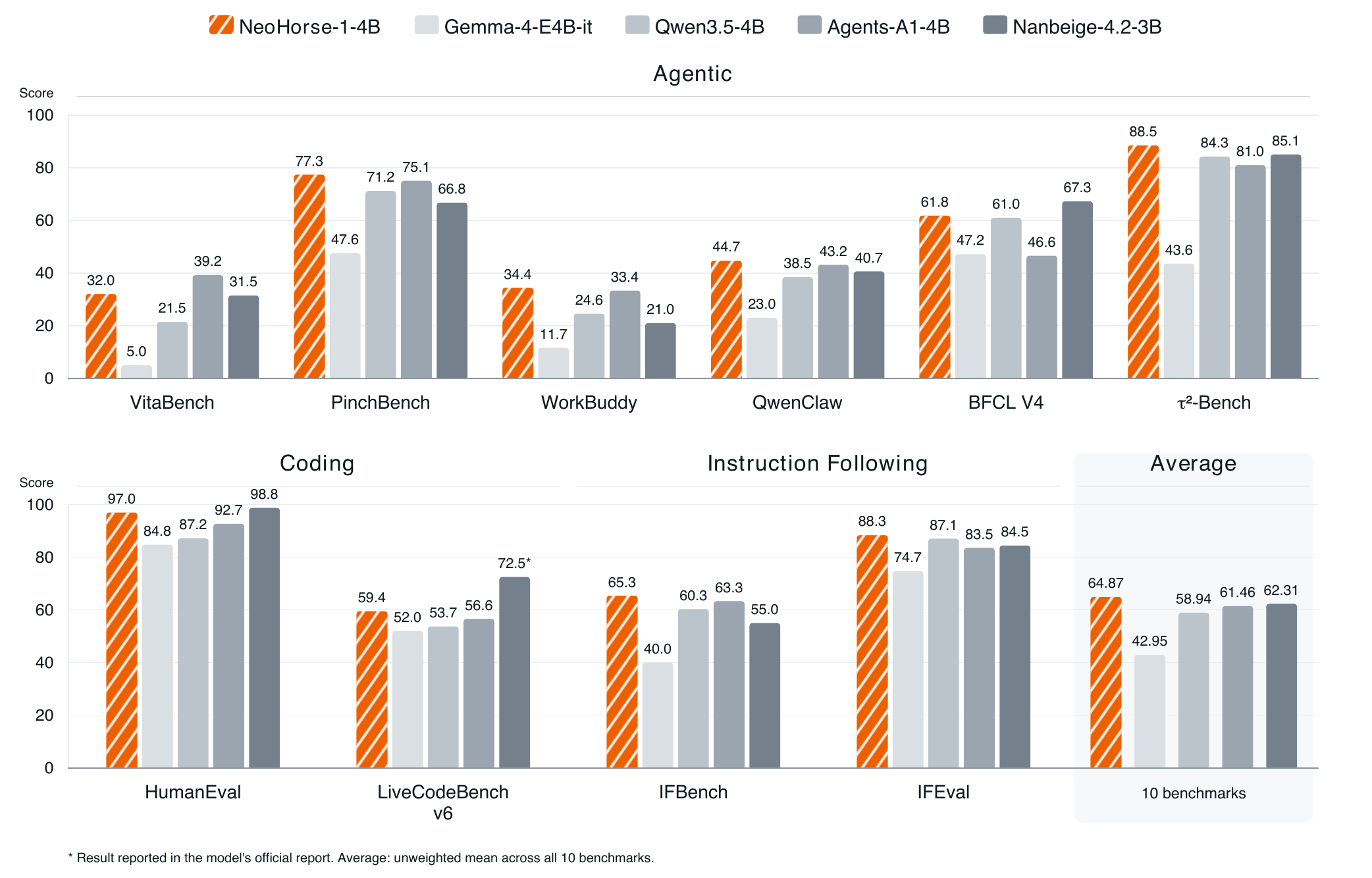
- Broad gains: 64.87 macro average across ten benchmarks versus 58.94 for Qwen3.5-4B (+5.93).
Model Details
Property Value
Model family NeoHorse Agent-Native Causal Language Model
Parameters Approximately 4B
Base model Qwen3.5-4B
Post-training Routing-guided agentic post-training
Interface Text input and text output
Context length 262,144 natively and extensible up to 1,010,000 tokens.
Weight format / precision Safetensors / BF16
Evaluation
The 4B track compares NeoHorse-1-4B with five representative open-weight models. Results are grouped by capability in the table below. Higher is better; Δ is NeoHorse-1-4B minus Qwen3.5-4B. Bold marks the best available result; underlining marks the second-best.
Benchmark Qwen3.5-4B Gemma-4-E4B-it Nanbeige-4.2-3B Agents-A1-4B Spark-X2.5-4B NeoHorse-1-4B Δ vs Qwen3.5-4B
🤖 Agentic
QwenClawBench
38.47
22.98
40.66
43.16
43.52
44.68
+6.21
WorkBuddy Bench
24.62
11.65
21.03
33.37
26.47
34.41
+9.79
PinchBench
71.19
47.60
66.78
75.07
62.37
77.33
+6.14
VitaBench
21.50
5.00
31.50
39.25
37.00
32.00
+10.50
BFCL v4
61.02
47.18
67.28
46.60
63.71
61.79
+0.77
tau2-Bench
84.29
43.60
85.08
81.00
77.72
88.46
+4.17
💻 Coding
HumanEval
87.20
84.76
98.78
92.68
92.07
96.95
+9.75
LiveCodeBench v6
53.71
52.00
72.50*
56.57
54.86
59.43
+5.72
📚 Instruction Following
IFBench
60.33
40.00
55.00
63.33
73.33
65.33
+5.00
IFEval
87.06
74.68
84.47
83.55
91.13
88.35
+1.29
📊 Overall
Ten-benchmark average
58.94
42.95
62.31
61.46
62.22
64.87
+5.93
* Nanbeige-4.2-3B LiveCodeBench v6 result is reported in the corresponding model's official blog post or technical report.
Reported protocol: SGLang v0.5.17 ·
temperature=1.0·top_p=0.95·top_k=20·min_p=0.0·presence_penalty=1.5·repetition_penalty=1.0· thinking mode enabled withenable_thinking=trueandforce_nonempty_content=true. QwenClawBench, WorkBuddy Bench, and tau2-Bench use three runs; PinchBench and VitaBench use one run; the remaining benchmarks follow their official protocols. VitaBench uses the DeepSeek-V4-Flash simulator and judge.
Deployment
The examples below are for self-hosted deployment from a downloaded local checkpoint.
Local checkpoint path
The examples below assume the checkpoint has already been downloaded to local disk. Set MODEL_PATH to the directory containing config.json, tokenizer files, and model weights.
MODEL_PATH="/path/to/NeoHorse-1-4B"
The OpenAI-compatible requests below use the server's --served-model-name (for example, neohorse-1-4b), not the filesystem path.
SGLang
The technical report uses SGLang v0.5.17.
pip install "sglang==0.5.17"
MODEL_PATH="/path/to/NeoHorse-1-4B"
python3 -m sglang.launch_server \
  --model-path "$MODEL_PATH" \
  --served-model-name neohorse-1-4b \
  --host 0.0.0.0 \
  --port 30000 \
  --context-length 262144 \
  --reasoning-parser qwen3 \
  --tool-call-parser qwen3_coder
Send an OpenAI-compatible request after the server starts:
curl http://localhost:30000/v1/chat/completions \
  -H 'Content-Type: application/json' \
  -d '{"model":"neohorse-1-4b","messages":[{"role":"user","content":"Write a Python function that returns the first n Fibonacci numbers."}],"max_tokens":512}'
vLLM
pip install -U vllm
MODEL_PATH="/path/to/NeoHorse-1-4B"
vllm serve "$MODEL_PATH" \
  --served-model-name neohorse-1-4b \
  --host 0.0.0.0 \
  --port 8000 \
  --max-model-len 262144 \
  --reasoning-parser qwen3 \
  --enable-auto-tool-choice \
  --tool-call-parser qwen3_coder
The server exposes an OpenAI-compatible /v1/chat/completions endpoint. Send a request after the server starts:
curl http://localhost:8000/v1/chat/completions \
  -H 'Content-Type: application/json' \
  -d '{"model":"neohorse-1-4b","messages":[{"role":"user","content":"Write a Python function that returns the first n Fibonacci numbers."}],"max_tokens":512}'
The examples use the configured 262,144-token context limit. Actual capacity depends on GPU memory and serving settings; reduce the context limit if needed.
License
NeoHorse-1-4B is released under the Apache License 2.0.
The upstream model is Qwen/Qwen3.5-4B. Its original copyright notice, Copyright 2026 Alibaba Cloud, is retained in the license file. TokenRhythm has modified the model through fine-tuning and repackaging for text-only inference. Modification notices are included in this model card and the released configuration, weight index, and Safetensors metadata.
Citation
@misc{neohorse2026,
  title        = {NeoHorse-1: Towards Recursive Self-Improvement via Agentic Post-Training with Routing Harness},
  author       = {NeoHorse Team},
  year         = {2026},
  howpublished = {arXiv preprint},
  eprint       = {2609.08183},
  archivePrefix = {arXiv},
  primaryClass = {cs.CL},
  url          = {https://arxiv.org/abs/2609.08183}
}
For questions or issue reports, use the NeoHorse project repository.
Derived on Sep 16, 2026 from Hugging Face at revision 56f0584b, README.md , config.json .